Ever Have to Take the Naplex Again
We demand to make sure this tin can never happen once again
Can you moving-picture show this scenario?
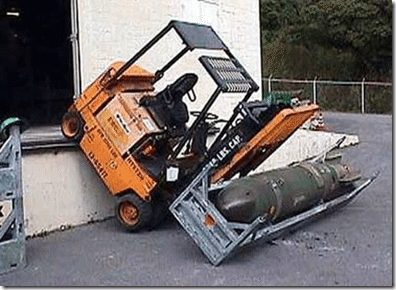 Manager: So Ben, I've simply read through the incident study and I see you injured your back when you lot ran the forklift into the bollard. I need to ask you lot a few questions every bit we demand to make certain this type of incident never happens again. It'south not acceptable that any of our team is hurt at piece of work. So lets start by looking at your forklift license?
Ben: Certain hither it is, I renewed it merely 2 months agone. Hey boss, y'all know that information technology's not the kickoff time the bollards have been striking, don't you?
Director: That's great, your license is electric current. Let's not worry almost any other incidents at present Ben, it volition merely distract us from reviewing this incident. One of the things that makes a good investigation is focus. Now lets look at your training records, when was the last time you did a forklift re-induction?
Ben: Nosotros did ane of those 'Toolboxy things' a couple of weeks ago, it's all good I signed the class. Do y'all recall it matters that sometimes I have trouble seeing that bollard, it'south kind of in an awkward spot?
Director: This is great, looks like we are compliant with your license and training records and that's of import. I'll need to take copies for our file. Like I said, we tin can look at the bollard later. Right now, we need to focus on this investigation.
Manager: OK, last thing we need to do is complete the department of the form that asks what we are going to do to brand sure this type of incident never happens once again. It's important that we consult with our employees Ben, and so do you take any ideas?
Ben: Sure boss, I retrieve I just need to take a bit more care when driving, I'm a good driver and I volition be more conscientious adjacent fourth dimension. Although that bollard does seem to be a problem, oh and there are some times when the brakes seem a bit spongy, maybe we can look at them also?
Manager: That sounds great Ben, we know you're a good bloke and you didn't hateful to practise this, information technology was an accident and yep you just need to be more careful mate, these forklifts can be dangerous machines.
So let's wrap this upwards at present that we have got to the bottom of things. We know you have a license, and that you take been trained and re-inducted, and we now have an improvement idea to make sure this type of incident never happens again. Thanks for mentioning the brakes, that'southward a expert one. I'll brand certain that the final maintenance report for the forklift is on the file, that will testify that the brakes were checked according to the schedule. I think we are all done now, the form is complete, that'due south great.
Oh past the mode Ben, if your back keeps playing up allow me know, merely I'chiliad sure you lot'll be ok. You lot know we accept a Physio who tin help and I can conform everything so you tin stay here at work being a productive and valued member of our team.
Ben: Thanks boss, I'm sure information technology will be all-good, I don't want to crusade any trouble.
Director: Well done Ben, thanks for being honest and involved in this important procedure. I'm confident that yous will be more careful from now on. That is all I really need from you at present Ben, thanks.
What did Ben's director acquire from this investigation?
Take you e'er been involved in an incident investigation that was really just a checklist of organisational processes? Have there been times when y'all might have missed something because yous became also focused on ane aspect and weren't open to exploring?
I've been in these situations. I've written reports that were focused on checking off on corporate procedures rather than on understanding what really went on. I've prepared reports that were 'protected' by legal professional privilege so that what nosotros learnt could not exist shared with others. I've written reports where I know that there were a range of other factors at play, but I had neither the fourth dimension nor resources to explore them, and then I 'parked them' for afterwards (they are still parked!). Is this normal in chance and rubber, or is this just my feel?
If this is our approach, what chance do nosotros actually have of learning anything?
Alternatively, does an investigation always have to be considered 'complete', or is information technology only the starting point for thinking and reflecting? If we accept that most of our decisions and judgments are fabricated in our non-conscious, are we e'er actually able to 'go to the bottom of things'? What does it really mean when nosotros advise to 'make certain this blazon of incident never happens again'?
If we are left with more questions than answers, could this be a 'expert' investigation?
I was reminded of how clinical the 'incident investigation' processes can be when I received an electronic mail from a friend this week asking for my thoughts on an investigation that they are involved in. The assist they were seeking was about how to raise the issue of a less clinical incident investigation process with a team of managers whose focus is on compliance.
1 mode to explore things differently is by considering Dr Robert Long's 'Workspace', 'Headspace' and 'Groupspace' way of exploring which he recently wrote about Hither. I've used this arroyo myself to follow up on an outcome that also involved a forklift and I idea it might exist useful to share my experience.
To empathise the context, I prepared the report for an organisation I was working for (and not under legal privilege!) and we actually shared it with the health and rubber Regulator (WorkCover NSW). The report followed a serious incident where someone at work had their foot run over past a forklift. The person subsequently spent the following vi months receiving specialist medical treatment. Some exerts from the study I prepared are outlined below:
"WORKSPACE":
This Issue (the proper noun this company gives to 'incidents') highlighted that there were few formal controls in place to protect confronting the risk of mobile equipment (eastward.g. forklift) and pedestrians colliding. The forklift operates in tight spaces on some occasions and there are peak times when the forklift is required to be used.
The team at the site identified that the time clock was located in an area that required people to walk into the path of the forklift. The team also identified the number of times that people walked through the share space could be express. They implemented a gate that is now used when the forklift is in operation and as well inverse the location of some of the racking that was normally used then that it was in an surface area where pedestrians don't go. All of these ideas came from people working at the site.
"HEADSPACE"
There are many factors that bear upon on the way people make decisions and judgments, a lot of these occur in the non-conscious, a-rational listen (as opposed to rational, logical and belittling decisions). Some 'headspace' factors that may accept contributed to this Result include the operator of the forklift being distracted; Mary (injured worker) not being aware that the forklift was about to motion on and (not-conscious) determination making and complacency and over confidence by the forklift operator.
This should non be dislocated with deliberate intent or neglect, rather acknowledgement that the decision to drive in the direction of Mary was not likely a conscious 'pick' but rather based on the physical 'cue' that Mary was walking. These factors can be difficult to predict and control. The key way to bargain with 'headspace' factors is to encourage a culture of open up questions and 'entertaining doubtfulness' that assists in dealing with the possibility of complacency.
"GROUPSPACE"
Groupspace factors are those where the unlike departments on site work together. I of the central recommendations agreed to past both departments (operations and sales) was to regularly catch up with each other (in Weick terms 'updating') which will assist to develop a culture and surroundings where relevant data is shared and learning is maximized.
Nosotros likewise considered some aspects of culture at the site. For instance, we explored the words and phrases that are ordinarily used and discovered that 'nosotros only get things done' was a common phrase people use on site. Another was 'everything we do is about the customer'. We sat and idea for a while about what these phrases could actually hateful and exercise to us. We've agreed that they probably do bear on on how go nigh things and decided to think near this for a while longer and come back in a calendar month and talk through once more.
Ah, the power of reflection!
What is your approach to investigating incidents?
Do you extend your line of thinking across the typical approaches to incident investigation and 'explore', 'imagine' and 'mind'?
Is agreement and coping with ambiguity and equivocality i of the fundamental skills nosotros demand to acquire if we are going to exercise an constructive investigation? In fact, should we utilise the give-and-take 'investigation' at all? What is the discourse ordinarily associated with the word 'investigation'. What other words do you think we could apply that would better describe a process that is focused on exploring and learning?
Exercise we 'satisfice' when we make decisions and judgments? Can we ever really 'prevent this from ever happening again'? What are the trade-offs and by-products of this arroyo? There are and so many questions.
Do we need to find answers to all questions, or are nosotros comfortable with ambiguity?
As usual, I'd beloved to hear your thoughts, experiences and comments.
Author: Robert Sams
Telephone: 0424 037 112
Email: robert@dolphyn.com.au
Spider web: world wide web.dolphyn.com.au
Facebook: Follow Dolphyn on Facebook
- Bio
- Latest Posts
- More about Rob

Rob is an experienced prophylactic and people professional person, having worked in a broad range of industries and work environments, including manufacturing, professional services (building and facilities maintenance), healthcare, transport, automotive, sales and marketing. He is a passionate leader who enjoys supporting people and organizations through periods of change. Rob specializes in making the challenges of risk and safety more than understandable in the workplace. He uses his substantial skills and formal training in leadership, social psychology of risk and coaching to assist organizations understand how to improve manage people, risk and performance. Rob builds relationships and "scaffolds" people development and change so that organizations can achieve the meaningful goals they set for themselves. While Rob has specialist knowledge in systems, his passion is in making systems useable for people and organizations. In many means, Rob is a translator; he interprets the complex language of processes, regulations and legislation into meaningful and practical tasks. Rob uses his cognition of social psychology to assistance people and organizations filter the many pressures they are made anxious virtually by regulators and various media. He is able to bring the many complexities of systems demands down to earth to a relevant and applied level.
mcleodfultentreske.blogspot.com
Source: https://safetyrisk.net/we-need-to-make-sure-this-can-never-happen-again/
0 Response to "Ever Have to Take the Naplex Again"
ارسال یک نظر