Rome Never Fell Into Civil War Again After Diocletian Separated Empire Into Four Divisions
The Roman Empire, at its height (c. 117 CE), was the near all-encompassing political and social structure in western culture. Past 285 CE the empire had grown too vast to be ruled from the central authorities at Rome and so was divided by Emperor Diocletian (r. 284-305 CE) into a Western and an Eastern Empire. The Roman Empire began when Augustus Caesar (r. 27 BCE-xiv CE) became the first emperor of Rome and ended, in the due west, when the concluding Roman emperor, Romulus Augustulus (r. 475-476 CE), was deposed past the Germanic Rex Odoacer (r. 476-493 CE). In the east, it connected as the Byzantine Empire until the death of Constantine XI (r. 1449-1453 CE) and the fall of Constantinople to the Ottoman Turks in 1453 CE. The influence of the Roman Empire on western civilization was profound in its lasting contributions to virtually every attribute of western culture.
The Early Dynasties
Following the Battle of Actium in 31 BCE, Gaius Octavian Thurinus, Julius Caesar'south nephew and heir, became the get-go emperor of Rome and took the proper noun Augustus Caesar. Although Julius Caesar is often regarded equally the first emperor of Rome, this is wrong; he never held the title `Emperor' but, rather, `Dictator', a title the Senate could not help merely grant him, as Caesar held supreme military and political power at the time. In contrast, the Senate willingly granted Augustus the title of emperor, lavishing praise and power on him because he had destroyed Rome's enemies and brought much-needed stability.
Augustus: "I constitute Rome a city of dirt but left information technology a city of marble."
Augustus ruled the empire from 31 BCE until 14 CE when he died. In that fourth dimension, every bit he said himself, he "found Rome a urban center of dirt but left information technology a city of marble." Augustus reformed the laws of the metropolis and, by extension, the empire's, secured Rome's borders, initiated vast building projects (carried out largely by his faithful general Agrippa (l. 63-12 BCE), who built the first Pantheon), and secured the empire a lasting name as 1 of the greatest, if not the greatest, political and cultural powers in history. The Pax Romana (Roman Peace), also known as the Pax Augusta, which he initiated, was a fourth dimension of peace and prosperity hitherto unknown and would last over 200 years.
Post-obit Augustus' death, power passed to his heir, Tiberius (r. fourteen-37 CE), who continued many of the emperor's policies but lacked the strength of character and vision which and then defined Augustus. This trend would continue, more than or less steadily, with the emperors who followed: Caligula (r. 37-41 CE), Claudius (r. 41-54 CE), and Nero (r. 54-68 CE). These first five rulers of the empire are referred to every bit the Julio-Claudian Dynasty for the two family unit names they descended from (either by birth or through adoption), Julius and Claudius. Although Caligula has become notorious for his depravity and apparent insanity, his early on dominion was laudable as was that of his successor, Claudius, who expanded Rome'due south power and territory in United kingdom; less so was that of Nero. Caligula and Claudius were both assassinated in part (Caligula past his Praetorian Baby-sit and Claudius, apparently, by his wife). Nero's suicide ended the Julio-Claudian Dynasty and initiated the period of social unrest known as The Year of the Four Emperors.
These four rulers were Galba, Otho, Vitellius, and Vespasian. Following Nero's suicide in 68 CE, Galba assumed rule (69 CE) and about instantly proved unfit for the responsibility. He was assassinated past the Praetorian Guard. Otho succeeded him swiftly on the very twenty-four hours of his expiry, and ancient records point he was expected to brand a good emperor. General Vitellius, however, sought ability for himself and then initiated the brief civil war which ended in Otho'southward suicide and Vitellius' ascension to the throne.
Vitellius proved no more fit to rule than Galba had been, as he well-nigh instantly engaged in luxurious entertainments and feasts at the expense of his duties. The legions declared for General Vespasian equally emperor and marched on Rome. Vitellius was murdered by Vespasian's men, and Vespasian (r. 69-79 CE) took power exactly 1 year from the day Galba had commencement ascended to the throne.
Vespasian founded the Flavian Dynasty which was characterized by massive edifice projects, economic prosperity, and expansion of the empire. Vespasian reign was prosperous as evidenced by his building projects which included initial construction of the Flavian Amphitheatre (the famous Coliseum of Rome) which his son Titus (r. 79-81 CE) would complete. Titus' early reign saw the eruption of Mount Vesuvius in 79 CE which buried the cities of Pompeii and Herculaneum.
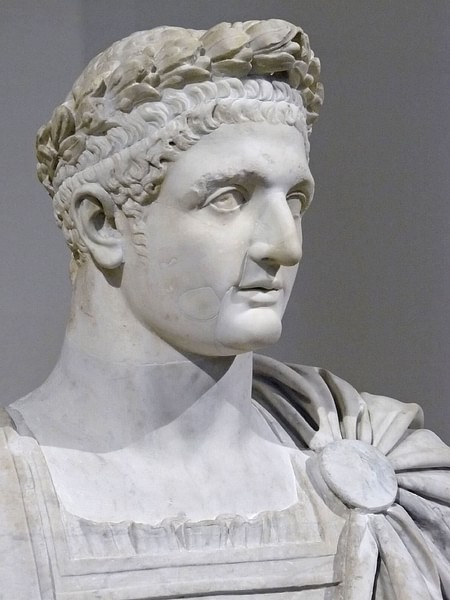
Roman Emperor Domitian, Louvre
Ancient sources are universal in their praise for his handling of this disaster as well as the swell fire of Rome in eighty CE. Titus died of a fever in 81 CE and was succeeded past his brother Domitian (r. 81-96 CE). Domitian expanded and secured the boundaries of Rome, repaired the damage to the city caused by the smashing fire, continued the building projects initiated by his brother, and improved the economy of the empire. All the same, his autocratic methods and policies made him unpopular with the Roman Senate, and he was assassinated in 96 CE.
The Five Practiced Emperors
Domitian's successor was his advisor Nerva who founded the Nervan-Antonin Dynasty which ruled Rome 96-192 CE. This period is marked by increased prosperity owing to the rulers known as The Five Good Emperors of Rome. Betwixt 96 and 180 CE, five exceptional men ruled in sequence and brought the Roman Empire to its height:
- Nerva (r. 96-98 CE)
- Trajan (r. 98-117 CE)
- Hadrian (r. 117-138 CE)
- Antoninus Pius (r. 138-161 CE)
- Marcus Aurelius (r. 161-180 CE)
Nether their leadership, the Roman Empire grew stronger, more than stable, and expanded in size and scope. Lucius Verus and Commodus are the final two of the Nervan-Antonin Dynasty. Verus was co-emperor with Marcus Aurelius until his death in 169 CE and seems to have been adequately ineffective. Commodus (r. 180-192 CE), Aurelius' son and successor, was one of the most disgraceful emperors Rome ever saw and is universally depicted as indulging himself and his whims at the expense of the empire. He was strangled by his wrestling partner in his bath in 192 CE, catastrophe the Nervan-Antonin Dynasty and raising the prefect Pertinax (who most likely engineered Commodus' bump-off) to ability.
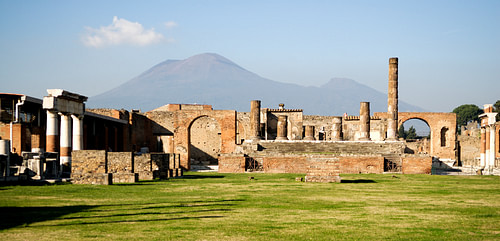
Pompeii and Mt. Vesuivus
The Severan Dynasty
Pertinax governed for simply 3 months earlier he was assassinated. He was followed, in rapid succession, by 4 others in the catamenia known as The Year of the Five Emperors, which culminated in the ascent of Septimus Severus to ability. Severus (r. 193-211 CE), founded the Severan Dynasty, defeated the Parthians, and expanded the empire. His campaigns in Africa and Britain were extensive and costly and would contribute to Rome's later fiscal difficulties. He was succeeded by his sons Caracalla and Geta, until Caracalla had his brother murdered.

Roman Beach Attack
Caracalla ruled until 217 CE, when he was assassinated by his bodyguard. It was nether Caracalla'south reign that Roman citizenship was expanded to include all free men inside the empire. This constabulary was said to accept been enacted as a ways of raising tax revenue, simply because, after its passage, there were more than people the fundamental regime could tax. The Severan Dynasty continued, largely nether the guidance and manipulation of Julia Maesa (referred to as `empress'), until the bump-off of Alexander Severus (r. 222-235 CE) in 235 CE which plunged the empire into the chaos known as The Crisis of the Third Century (lasting from 235-284 CE).
Two Empires: East & West
This period, likewise known equally The Imperial Crisis, was characterized by abiding civil state of war, as various military leaders fought for control of the empire. The crisis has been further noted by historians for widespread social unrest, economic instability (fostered, in part, by the devaluation of Roman currency by the Severans), and, finally, the dissolution of the empire which broke into three separate regions. The empire was reunited by Aurelian (270-275 CE) whose policies were farther developed and improved upon by Diocletian who established the Tetrarchy (the rule of four) to maintain gild throughout the empire.
The Imperial Crisis was characterized past constant civil war, every bit various military leaders fought for control of the empire.
Even so, the empire was still and then vast that Diocletian divided it in half in c.285 CE to facilitate more than efficient administration by elevating i of his officers, Maximian (r. 286-305 CE) to the position of co-emperor. In so doing, he created the Western Roman Empire and the Eastern Roman Empire (as well known every bit the Byzantine Empire). Since a leading cause of the Imperial Crisis was a lack of clarity in succession, Diocletian decreed that successors must be called and canonical from the outset of an individual's rule. Two of these successors were the generals Maxentius and Constantine. Diocletian voluntarily retired from rule in 305 CE, and the tetrarchy dissolved as rival regions of the empire vied with each other for authority. Following Diocletian's death in 311 CE, Maxentius and Constantine plunged the empire again into civil war.
Constantine & Christianity
In 312 CE Constantine defeated Maxentius at the Battle of the Milvian Span and became sole emperor of both the Western and Eastern Empires (ruling from 306-337 CE simply belongings supreme power 324-307 CE). Believing that Jesus Christ was responsible for his victory, Constantine initiated a series of laws such every bit the Edict of Milan (313 CE) which mandated religious tolerance throughout the empire and, specifically, tolerance for the faith which came to known as Christianity.
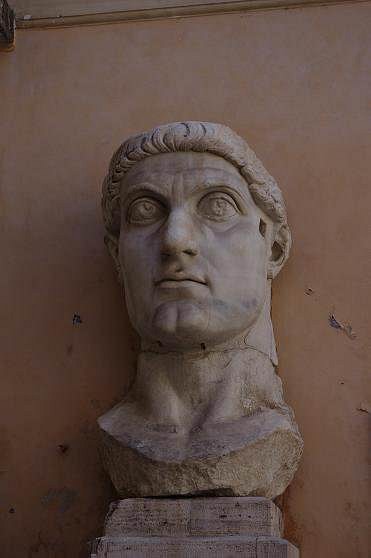
The Colossus of Constantine
In the same manner that before Roman emperors had claimed a special relationship with a deity to augment their authority and standing (Caracalla with Serapis, for case, or Diocletian with Jupiter), Constantine chose the figure of Jesus Christ. At the First Quango of Nicea (325 CE), he presided over the gathering to codify the faith and make up one's mind on important issues such as the divinity of Jesus and which manuscripts would be collected to course the book known today equally The Bible. He stabilized the empire, revalued the currency, and reformed the military, every bit well every bit founding the city he called New Rome on the site of the quondam metropolis of Byzantium (modernistic-24-hour interval Istanbul) which came to be known as Constantinople.
He is known as Constantine the Great attributable to after Christian writers who saw him as a mighty champion of their faith but, equally has been noted by many historians, the honorific could every bit easily be attributed to his religious, cultural, and political reforms, likewise equally his skill in battle and his large-calibration building projects. After his decease, his sons inherited the empire and, fairly chop-chop, embarked on a series of conflicts with each other which threatened to undo all that Constantine had accomplished.
His iii sons, Constantine Ii, Constantius 2, and Constans divided the Roman Empire between them but presently fell to fighting over which of them deserved more. In these conflicts, Constantine II and Constans were killed. Constantius Ii died later subsequently naming his cousin Julian his successor and heir. Emperor Julian ruled for only two years (361-363 CE) and, in that time, tried to return Rome to her former glory through a series of reforms aimed at increasing efficiency in government.
As a Neo-Platonic philosopher, Julian rejected Christianity and blamed the faith, and Constantine'southward advocacy for it, for the reject of the empire. While officially proclaiming a policy of religious tolerance, Julian systematically removed Christians from influential regime positions, banned the education and spread of the religion, and barred Christians from military service. His death, while on campaign confronting the Persians, ended the dynasty Constantine had begun. He was the last pagan emperor of Rome and came to be known as `Julian the Apostate' for his opposition to Christianity.
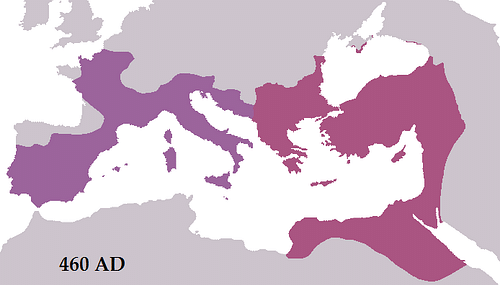
Byzantine Empire c. 460 CE
Later the brief rule of Jovian, who re-established Christianity as the dominant faith of the empire and repealed Julian'due south various edicts, the responsibleness of emperor fell to Theodosius I. Theodosius I (r. 379-395 CE) took Constantine's and Jovian's religious reforms to their natural ends, outlawed pagan worship throughout the empire, closed the schools and universities, and converted pagan temples into Christian churches after proclaiming Christianity Rome'south state faith in 380 CE.
The unity of social duties & religious belief which paganism provided was severed by the establishment of Christianity.
It was during this time that Plato'southward famous University was closed past Theodosius' prescript. Many of his reforms were unpopular with both the Roman elite and the common people who held to the traditional values of heathen practice. The unity of social duties and religious belief which paganism provided was severed past the establishment of a religion which removed the gods from the globe and human society and proclaimed merely 1 God who ruled from the heavens.
This new god, dissimilar the gods of old, had no special interest in Rome - he was the god of all people - and this distanced the faith of Rome from the state of Rome. Previously, Roman religious belief was land-sponsored and the rituals and festivals went to enhancing the condition of the authorities. Theodosius I devoted and then much effort to promoting Christianity that he seems to accept neglected other duties as emperor and would be the concluding to rule both Eastern and Western Empires.
The Autumn of the Roman Empire
From 376-382 CE, Rome fought a series of battles confronting invading Goths known today as the Gothic Wars. At the Battle of Adrianople, ix Baronial 378 CE, the Roman Emperor Valens (r. 364-378 CE) was defeated, and historians mark this issue equally pivotal in the decline of the Western Roman Empire. Diverse theories take been suggested equally to the cause of the empire'due south autumn but, even today, there is no universal agreement on what those specific factors were. Edward Gibbon has famously argued in his The History of the Decline and Fall of the Roman Empire that Christianity played a pivotal role, in that the new religion undermined the social mores of the empire which paganism provided.
The theory that Christianity was a root cause in the empire's fall was debated long before Gibbon, however, as the theologian Orosius (fifty. c. 5th century CE) argued Christianity's innocence in Rome's refuse as early as 418 CE. Orosius claimed it was primarily paganism itself and pagan practices which brought nigh the fall of Rome. Other contributing factors to Rome's fall include:
- Political instability due to size of empire
- The self-involvement of the 2 halves of the empire
- Invasion of barbarian tribes
- Government corruption
- Mercenary armies
- Over-reliance on slave labor
- Massive unemployment and inflation
The ungovernable vastness of the empire, even divided in two, fabricated it difficult to manage. The Eastern Empire flourished while the Western Empire struggled and neither gave much thought to helping the other. Eastern and Western Rome saw each other more than as competitors than teammates and worked primarily in their own self-interest. The growing strength of the Germanic tribes and their constant incursions into Rome could have been dealt with more finer if non for government corruption, especially amid provincial governors, and fair treatment of the Goths by the Romans overall.
The Roman military, manned largely with barbarian mercenaries who had no ethnic ties to Rome, could no longer safeguard the borders as efficiently as they once had nor could the government as easily collect taxes in the provinces. Further, the debasement of the currency, begun under the Severan Dynasty, had steadily encouraged inflation and slave labor, which was widespread, deprived lower-class citizens of jobs so unemployment levels soared. The arrival of the Visigoths in the empire in the third century CE, fleeing from the invading Huns, and their subsequent rebellions has also been cited a contributing factor in the decline.

Invasions of the Roman Empire
The Western Roman Empire officially concluded four September 476 CE, when Emperor Romulus Augustulus was deposed by the Germanic King Odoacer (though some historians date the finish every bit 480 CE with the decease of Julius Nepos). The Eastern Roman Empire continued on as the Byzantine Empire until 1453 CE, and though known early on as only `the Roman Empire', it did not much resemble that entity at all. The Western Roman Empire would become re-invented later as The Holy Roman Empire (962-1806 CE), but that construct, also, was far removed from the Roman Empire of antiquity and was an `empire' in name only.
Legacy of the Roman Empire
The inventions and innovations which were generated by the Roman Empire profoundly altered the lives of the aboriginal people and continue to be used in cultures effectually the earth today. Advancements in the structure of roads and buildings, indoor plumbing, aqueducts, and even fast-drying cement were either invented or improved upon by the Romans. The agenda used in the W derives from the one created past Julius Caesar, and the names of the days of the week (in the romance languages) and months of the twelvemonth too come up from Rome. Even the do of returning some purchase one finds one does not want comes from Rome whose laws made it legal for a consumer to bring back some lacking or unwanted merchandise to the seller.
Apartment complexes (known equally `insula), public toilets, locks and keys, newspapers, even socks all were developed past the Romans as were shoes, a postal organisation (modeled after the Persians), cosmetics, the magnifying glass, and the concept of satire in literature. During the time of the empire, significant developments were also advanced in the fields of medicine, police, religion, government, and warfare. The Romans were adept at borrowing from, and improving upon, those inventions or concepts they plant amid the indigenous populace of the regions they conquered. It is therefore hard to say what is an `original' Roman invention and what is an innovation on a pre-existing concept, technique, or tool. It can safely exist said, even so, that the Roman Empire left an enduring legacy which continues to affect the way in which people live in the present solar day.
This article has been reviewed for accuracy, reliability and adherence to academic standards prior to publication.
mcleodfultentreske.blogspot.com
Source: https://www.worldhistory.org/Roman_Empire/
0 Response to "Rome Never Fell Into Civil War Again After Diocletian Separated Empire Into Four Divisions"
ارسال یک نظر